Are You AWARE
of what the Legal NAME
is that
you use everyday?
It’s NOT YOU. Your birth record can show one date for when the living child was born and another for when the official record was filed or registered. Those are not the same event.
Now think about the question institutions ask every day:
“Your NAME and date of birth, please.”
What exactly does the NAME identify — and which date is being associated with it?
A biological event happened.
The child was born on a specific day.
An administrative event followed.
The record was filed or registered and can show a later date.
If an institution asks for NAME + date of birth, what exactly is being identified?
DID YOU KNOW FINANCIAL LAW CONSTANTLY DISTINGUISHES CREDITS, DEBITS, OBLIGATIONS, OWNERS AND RECIPIENTS?
Which position are you operating from when you use the Legal NAME?
“Here is a corrected credit file, 07/17 bio date of birth … 7/27 corrected to the proper date of birth.”
“Your NAME and date of birth, please.”
Banks ask it. Credit companies ask it. Government offices ask it. Police and courts ask it. Most people answer automatically because nobody ever taught them to separate the living person, the official record, the NAME being used, and the dates shown on that record.
The regulations already use the language of credit, debit, obligation, ownership, beneficiary and recipient.
You do not have to accept anyone’s conclusion first. Start with the federal definitions and relationships in black and white — then ask what those words mean in the transactions and records you use every day.
A bank deposit is tied to a credit.
Regulation D defines a deposit to include the unpaid balance of money or its equivalent held by a depository institution for which the institution has given — or is obligated to give — credit to an account.
Read 12 CFR § 204.2 →Federal payments move through defined ACH relationships.
Part 210 defines ACH as interbank clearing of electronic entries and defines Federal payments broadly enough to include principal, interest and other payments connected with United States securities.
Read 31 CFR § 210.2 →The rules expressly speak in rights, obligations, credits and debits.
Part 210 says the rights and obligations surrounding Government ACH entries are governed by federal law. It also addresses agencies receiving ACH debit or credit entries and the liabilities attached to those entries.
Treasury itself distinguishes the roles.
TreasuryDirect separately defines terms including individual, entity, owner, beneficiary, recipient, primary owner, security, transfer and redemption. It defines a Treasury security as an obligation issued by Treasury.
Read 31 CFR § 363.6 →Registration determines who owns a Treasury security.
The regulation states that registration must express the actual ownership of and interest in a Treasury security, and that registration conclusively establishes ownership of that security.
Read 31 CFR § 363.20 →“The estate of a living person such as an incompetent or a minor.”
WHO IS THE DEBTOR? WHO IS THE CREDITOR? AND WHERE DO YOU ACTUALLY STAND?
If the law is careful enough to distinguish obligations, credits, debits, owners, beneficiaries, recipients, estates and legal representatives, why would you use the Legal NAME without first asking what capacity is being assigned to it — and to you?
ARE YOU USING THE LEGAL NAME — OR ARE INSTITUTIONS TREATING YOU AS THOUGH YOU ARE THE LEGAL NAME?
If the Legal NAME is used in contracts, credit, courts and government records — have you ever asked what capacity you are using it in?
Everything you need to go from “I never knew this” to “I can examine the records, build my own evidence found on EVERY Birth Certificate, and correct the records I identify as fraudulent.”
The membership brings the research, source material, templates, live education, recordings, community and public-record tools together in one organized working environment.
Understand the framework
People’s Complete Guide + Knowledge Base. Start with the two-date question, then move into the deeper research, source documents, examples and supporting material.
Put the research to work
25+ Document Templates + Public Gazette. Adapt notices, corrections and record-building material, then preserve the chronology and supporting evidence.
Learn with the community
2–3 live educational sessions each week + recordings. Ask questions during prelaunch, compare experiences and return to the growing Educational Series later.
Keep the system
Private community + lifetime core access. Stay connected while active, while the complete core system included with your initial Founding contribution remains yours.

 Core Library
 Public Recording Studio
 Live Classroom & Community
You do not need to learn everything at once.
Start with the record in front of you, then move one clear step at a time.
Examine
Compare the framework with your birth record, source documents, dates and terminology.
Document
Use the research and templates to preserve your questions, notices, responses, corrections and chronology.
Build the Record
Keep the evidence organized privately and, when appropriate, through the Public Gazette.
WHAT CHANGES WHEN YOU STOP AUTOMATICALLY ANSWERING — AND START ASKING WHAT THE RECORD ACTUALLY SAYS?
The examples below are why the member system focuses on records, corrections, responses and evidence — not simply opinions.
See what members are documenting.
Real people. Real records. Our members are documenting corrections across credit files, court records, government agencies, and more. Explore their experiences, evidence, and breakthroughs — and see what’s possible when you know what to look for.
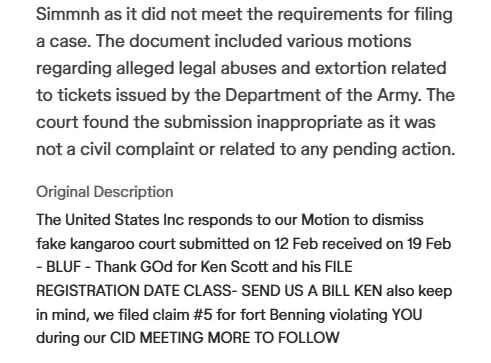
Court Confirms Improper Filing
“The court ordered the return of a document… The submission was not a civil complaint or related to any pending action.”
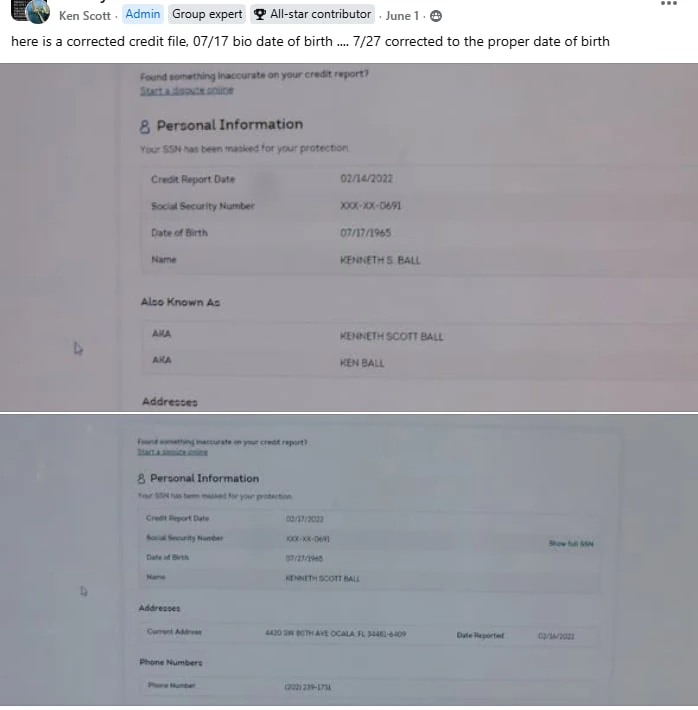
Corrected Date of Birth
“Here is a corrected credit file, 07/17 bio date of birth … 7/27 corrected to the proper date of birth.”

Real People. Real Impact.
“Thank you so much for all you have done to help free the people. I’ve donated and will donate more when possible.”
For people who would rather examine the record than simply accept the assumption.
There is no need to arrive with every answer. The member system is built for people willing to look, compare, document and keep learning.
Curious: you have never heard the legal-name/two-date question and want to see the research.
Research-minded: you want source documents, examples and a framework you can compare with your own records.
Action-oriented: you want templates and a repeatable way to document what happens next.
Community-minded: you want live education and a private place to compare experiences and discoveries.
BEFORE YOU SIGN, PAY, ANSWER OR APPEAR — DO YOU KNOW THE CAPACITY IN WHICH YOU ARE BEING ADDRESSED?
Get the complete Founding Member system for $199 before public launch.
Start with the working member portal that is already live, keep lifetime access to the core system, and receive continuing member-area releases as the Founding community grows.
Enter while the first Founding group is still open. Use what is available now and receive the continuing member-area releases as the system grows.
Need a lower entry point? Begin with $50 today.
Complete four monthly $50 contributions ($200 total). Founding community access begins after the first successful contribution. Knowledge Base and Document Templates unlock once the full $200 Founding contribution is completed.
Remove the uncertainty first.
The offer is simple; the questions below cover the most common reasons someone might hesitate.
What do I get immediately?
You receive access to the members portal and the Founding community experience that is already live, together with new lessons, recordings, templates, documents and member-area releases as they are added.
Do I have to accept the legal-name framework before joining?
No. The purpose is to give you the research, source material, documented experiences and tools to investigate the subject for yourself and compare it with your own records.
What happens after the first 3 months?
Your $199 Founding contribution includes the first 3 months of continuing community access. After that, active community access continues automatically at the locked $5/month Founding rate unless you cancel.
What remains if I cancel continuing community access?
Your lifetime access to the core system remains. Continuing community participation, ongoing podcasts, new updates and Public Gazette publishing are benefits of active community access.
What if I cannot manage $199 today?
The accessible Founding option is four monthly $50 contributions ($200 total). Community access begins after the first successful contribution; Knowledge Base and Document Templates unlock after the full $200 Founding contribution is completed.
Is this legal advice or a promise of a result?
No. The site provides education, research, personal experiences, documents, templates and community discussion for independent study and discernment. Results depend on each person’s facts, records, jurisdiction and actions.
One record. Two dates.
Start with your own evidence found on EVERY Birth Certificate.
Enter for $199 before the planned $399 public launch, receive the first 3 months of continuing community access, keep the $5/month Founding rate for life while active, and retain lifetime access to the complete core system.